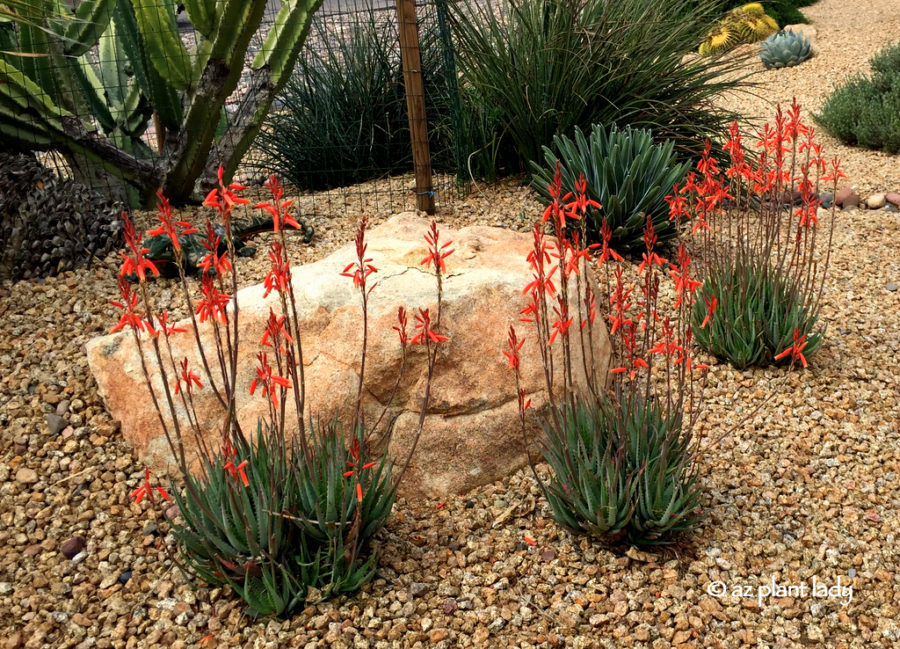
Aloe x 'Blue Elf'
Blue Elf Aloe
Aloe 'Blue Elf,' a captivating succulent, emerges as a valuable addition for landscape architects and designers seeking a unique and water-wise plant for their projects. Known for its striking blue-green leaves and vibrant blooms, this aloe variety brings a touch of elegance and resilience to arid landscapes.
Origin and Adaptability:
Originating from South Africa, Aloe 'Blue Elf' thrives in arid conditions, making it an excellent choice for landscape designs in water-scarce environments. Its native habitat provides insights into its remarkable adaptability, showcasing a plant that can endure and flourish in challenging climates.
Architectural Form and Foliage:
This aloe variety boasts an architectural elegance with its rosette of blue-green leaves that gracefully arch upwards. The leaves, armed with small teeth along the edges, contribute to a sculptural quality, providing a distinctive focal point or complementing other succulents in a well-designed landscape. Aloe 'Blue Elf' is known for its cluster of tubular coral-red flowers that appear on slender, upright stems, adding a burst of color to the setting. These blooms typically emerge early winter to early spring, but can bloom sporadically as well.
Light Requirements and Growth Speed:
Aloe 'Blue Elf' is a heat loving selection that thrives in full sun to partial shade, making it versatile for a range of design scenarios. If planting in extreme heat regions, consider planting in partial shade for better success. Designers can strategically place it to capture the play of sunlight on its blue-green foliage. In terms of growth, this aloe exhibits a moderate speed, allowing for effective planning and integration into landscape designs.
Wildlife Attraction:
The tubular flowers of Aloe 'Blue Elf' are not only visually appealing but also attract pollinators and hummingbirds, making it a beneficial addition to designs focused on supporting local biodiversity. Bees and other pollinators are drawn to the nectar-rich blooms, enhancing the ecological balance of the outdoor space.
Challenges and Considerations:
While Aloe 'Blue Elf' is a low-maintenance and hardy succulent, designers should consider its eventual size and form when planning its placement. The plant's moderate growth rate and clumping nature provide flexibility in design, allowing for creative arrangements that highlight its unique features.
Integration into Contemporary Designs:
With its striking aesthetics and adaptability, Aloe 'Blue Elf' seamlessly integrates into both traditional and contemporary landscape designs. Its ability to withstand harsh conditions, coupled with its water-wise attributes, positions it as a versatile choice for designers aiming to create visually engaging and sustainable outdoor environments.
Designing with Aloe 'Blue Elf':
Landscape architects can leverage the distinctive features of Aloe 'Blue Elf' to enhance the visual appeal of their designs. Whether used as a standalone specimen, part of a drought-tolerant palette, or integrated into modern xeriscape concepts, this aloe variety contributes both aesthetic allure and practical resilience to outdoor spaces.
For landscape architects and designers, Aloe 'Blue Elf' offers an opportunity to infuse water-wise elegance into their projects, combining unique visual qualities with adaptability, thereby contributing to the creation of resilient and visually captivating outdoor environments.
FAMILY
Liliaceae
MATURE HEIGHT
1 to 2 ft
GROWTH HABIT
Aloe 'Blue Elf' exhibits a dense, upright, and clump-forming growth habit with a moderate growth rate. Its growth is characterized by the production of lateral offsets that form tight rosettes of leaves and expand outwards to create dense clusters.
WATER REQUIREMENT
Drought Tolerant
HARDY TO
18°F
NATIVE REGION
South Africa
TYPE
Accent Succulent
SOIL TYPE
Well drained. Prefers poor soil content that is arid, gritty, and rocky. Does not have a specific soil pH preference.
MAINTENACE TIPS
Once established, it is highly drought-tolerant and requires infrequent, deep watering, particularly during the active growing season (spring through fall); watering should be reduced significantly during the dormant winter months. The plant naturally produces numerous offsets (pups) that form dense clumps. For division, it is recommended to separate these offsets in early spring or every 2-3 years, when the clumps become overcrowded. Use a sharp, sterilized cutting tool to sever the offsets from the parent plant, ensuring each division has a portion of its own roots. The separated offsets should be allowed to form a protective callous over the cut surface for several days before repotting in a well-draining succulent mix to promote successful rooting.
ELEVATION
Sea level to 4800 feet
MATURE WIDTH
1 to 2 ft
LEAF SHAPE
The evergreen foliage of the hybrid Aloe 'Blue Elf' is characterized by its sessile, succulent, and upright-spreading leaves, which form dense, clustered rosettes. The leaves are lanceolate, with a silvery-blue to blue-green coloration that is influenced by light intensity; more intense sun exposure can induce a lighter green tone or a pinkish-reddish stress blush at the leaf tips and margins, while plants in more shade maintain a deeper blue-green. Each leaf features small, sharp, reddish-brown teeth along its cartilaginous margins and terminates in an acute apex. The surface of the leaves is covered with a protective, waxy cuticle that helps the plant minimize water loss through transpiration, an adaptation for its drought-tolerant nature.
FLOWER COLOR
Bright Orange
FLOWER CHARACTERISTICS
Aloe 'Blue Elf' produces an inflorescence consisting of a raceme of bright orange, tubular flowers. Typically appearing on an erect, unbranched 12-inch scape during late winter and early spring, the flowers are pendulous and narrow, with their tepals flaring slightly at the apex. These repeat-blooming nectar-rich blooms are well-documented for their high attractiveness to hummingbirds as the shape enables the hummingbird to sup the flower's nectar easily.
FRUIT/SEED
Aloe × 'Blue Elf', a hybrid succulent, primarily propagates vegetatively through offsets, or "pups," and is not commonly grown or observed for fruit and seed production in horticulture. When formed, the fruit structure is a small, dry, dehiscent pod or capsule that develops from the pollinated tubular flowers, with the characteristic fruit morphology consistent with the genus Aloe. Within this capsule, seeds are produced and, upon maturation and drying, the fruit splits open to release its contents. The seeds are minute and typically possess small, papery wings, an adaptation that aids in wind dispersal. Given its hybrid nature and strong tendency to produce vegetative offsets, seed viability can be low, and propagation is almost exclusively carried out by dividing the tight clumps of rosettes.
SUN EXPOSURE
Full Sun, Partial Shade, Shade
POLLINATORS
Hummingbirds and butterflies. Rabbit and deer resistant.
PRUNING TIPS
Minimal pruning is recommended for Aloe x 'Blue Elf' to maintain plant health and aesthetics, with removal primarily focused on necrotic tissue and spent inflorescences. After flowering, the spent stalk should be removed by cutting as close to the base as possible to redirect the plant's metabolic energy toward vegetative growth rather than seed production. Similarly, senescent, damaged, or desiccated basal leaves should be removed at their point of origin to prevent resource diversion and reduce potential entry points for pathogens. To encourage healthy development, avoid removing healthy, actively photosynthesizing leaves, particularly new central growth, as this depletes the plant's stored resources. Always use clean, sharp cutting tools to minimize tissue damage and prevent disease transmission.